

STATE AUDIT OFFICE
– Press Release –
Skopje, 18 December 2025
Time-barred cases and unpaid funds to the State Budget, IT attacks, and multiple irregularities in the operations of the Ministry of Economy and Labor
The audit on the operations of the Ministry of Economy and Labor[1] for 2024 identified inappropriate handling of misdemeanor cases, public procurement management, IT security, and the procedures for categorization of hospitality accommodation facilities.
The State Audit Office conducted an audit of the financial statements together with a compliance audit of the Ministry of Economy and Labor for 2024.
Shortcomings, irregularities, and non-compliances were identified and qualified opinion was issued on the fairness and objectivity of the financial statements, an adverse opinion on the compliance with legal regulations, guidelines, and policies in place for the core budget account 637, unqualified opinion on the fairness and objectivity of the financial statements and a qualified opinion on compliance of activities, financial transactions, and information with the relevant legal regulations for the core budget account 631.
Based on the review of documentation, the auditors identified inappropriate actions by the Department for Misdemeanor, Judicial and Administrative Proceedings and the Misdemeanor Commission regarding requests for initiating misdemeanor proceedings pursuant to special laws, as well as cases initiated but not completed by the State Market Inspectorate, resulting in unpaid funds to the State Budget amounting to EUR 2.078.000.
Although the Misdemeanor Commission was established in 2019, the processing of cases began in 2022 with the establishment of a new commission. The submission of fully prepared documentation from the Department to the Commission is carried out after several years, while the preparation of acts arising from the minutes of the Misdemeanor Commission takes between two and seven months. On the other hand, the Department does not prepare monthly, semi-annual, or annual reports on its operations, which is contrary to the duties and obligations defined in the Rulebook on systematization.
By November 2024, due to the statute of limitations on requests for initiating misdemeanor proceedings, the Commission issued 1.534 decisions to terminate misdemeanor proceedings, resulting in lower revenues collected in the State Budget of 127.721.000 denars, i.e., EUR 2.078.000.
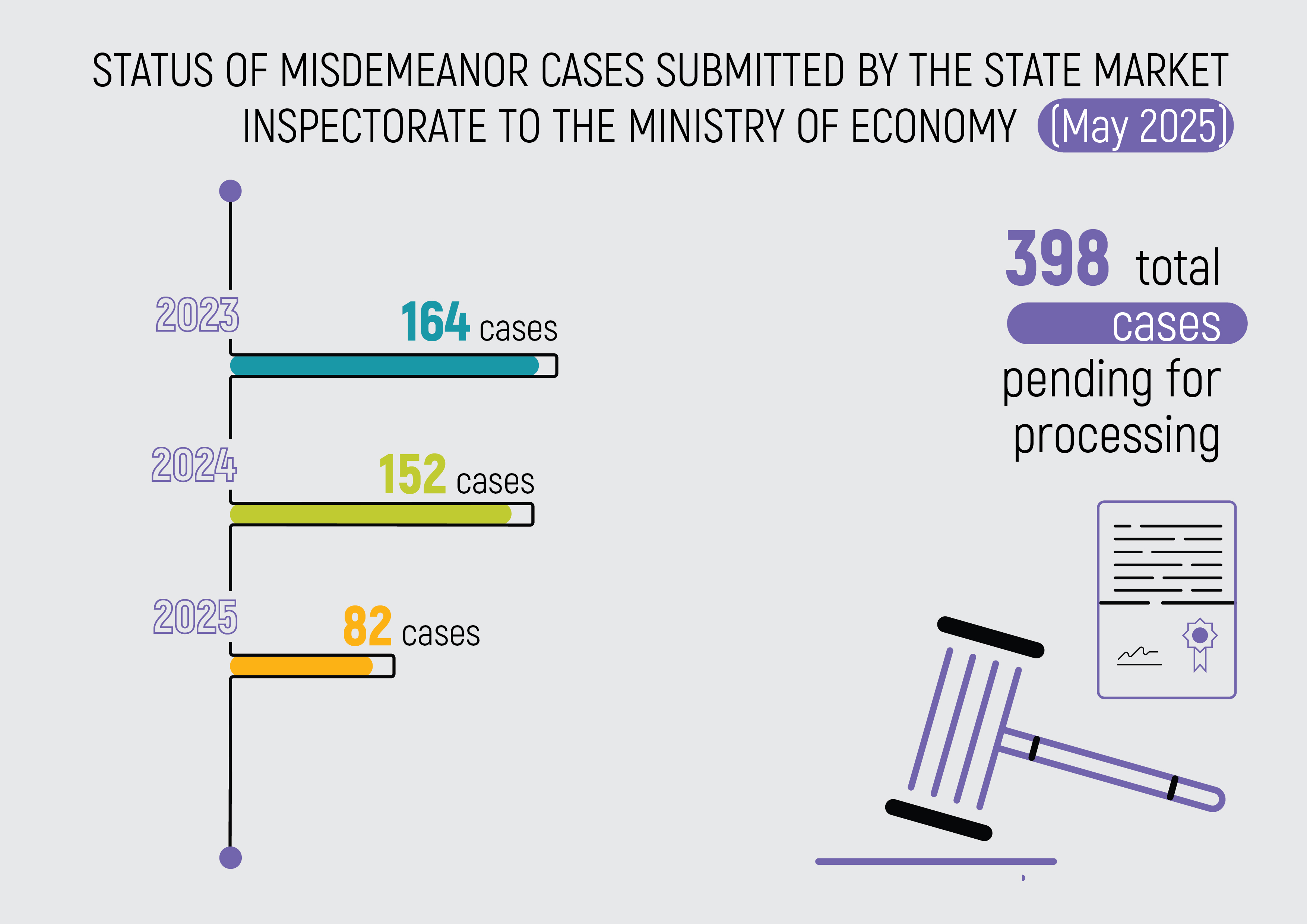
As of May 2025, the State Market Inspectorate submitted 398 cases to the Ministry of Economy and Labor for further action, of which 164 date from 2023, 152 from 2024, and 82 from 2025.
The audit also highlights that in September 2024, an unauthorized targeted attack was carried out on the software for misdemeanor cases, resulting in complete and irreversible loss of data.
For fencing parcels intended for the construction of photovoltaic power plants, the Ministry of Economy implemented two procurement phases. The first phase, with a contract value of 9.750.000 denars or EUR 158.536, was completed in accordance with the project and the construction permit. For the second phase, with a contract value of 25.871.000 denars or EUR 420.667, the procurement had not been implemented by the time of the audit; no bank guarantee for proper performance of the contract was provided; no annex for extension of the deadline was concluded; and no legal measures were taken to collect contractual penalties, thereby failing to achieve the objectives of the contract.
Due to amendments to the Law on the Organization and Operation of State Administration Bodies, the investment documentation was transferred to the Ministry of Energy, Mining, and Mineral Resources. However, by the time of the audit, no decision had been made on termination and permanent use, and thus, the funds are still recorded in the accounting of the Ministry of Economy and Labor.
During the audit, the Ministry of Energy, Mining, and Mineral Resources submitted a request to the State Attorney’s Office to initiate a lawsuit against the economic operator.
Regarding the IT sector, it was determined that it operates with only three employees out of 12 envisaged positions (25% capacity). In addition, no information security policies and procedures have been adopted, no information security officer has been appointed, and no IT risk analysis has been prepared.
Although a contract for backup software has been concluded, continuous monitoring and evidence of the integrity of backup copies are not defined, and an additional risk is the use of outdated operating systems without prescribed protection measures. The failure to take measures to ensure information security resulted in the Ministry of Economy and Labor being subject to a targeted IT attack in September 2024, causing the unavailability of all services, such as email addresses, the web server, and databases.
Despite the systems being restored after 37 days through backup copies, part of the data, including the electronic records of cases from the Legal Sector, was irreversibly lost.
In analyzing the legal framework for the performance of hospitality activities, shortcomings were identified in the process of issuing licenses and categorization of hospitality facilities. The law does not provide for mandatory verification of compliance with minimum technical, sanitary, and health, fire safety, and environmental requirements before issuing categorization decisions and operating licenses for hospitality facilities, nor a mechanism for verifying the commencement of operations.
Furthermore, no deadline is defined for the application of a legal remedy against a decision rejecting an application for a license or revoking a license for performing hospitality activities in a night bar, cabaret, disco club, or open-air disco club, and there is no mandatory register envisaged for issued licenses for hospitality activities.
The categorization of hospitality facilities, as well as the renewal of the validity of categorization decisions and licenses, is carried out upon submission of an application, without mandatory inter-institutional notification and action, which creates a risk of operating without meeting the required conditions or without valid documents.
The audit emphasizes that despite the legally defined obligation for supervision by the State Market Inspectorate and other inspection bodies, there are legal inconsistencies in the procedures for conducting inspection supervision and applying inspection measures, which may call into question the achievement of the objectives of inspection supervision.
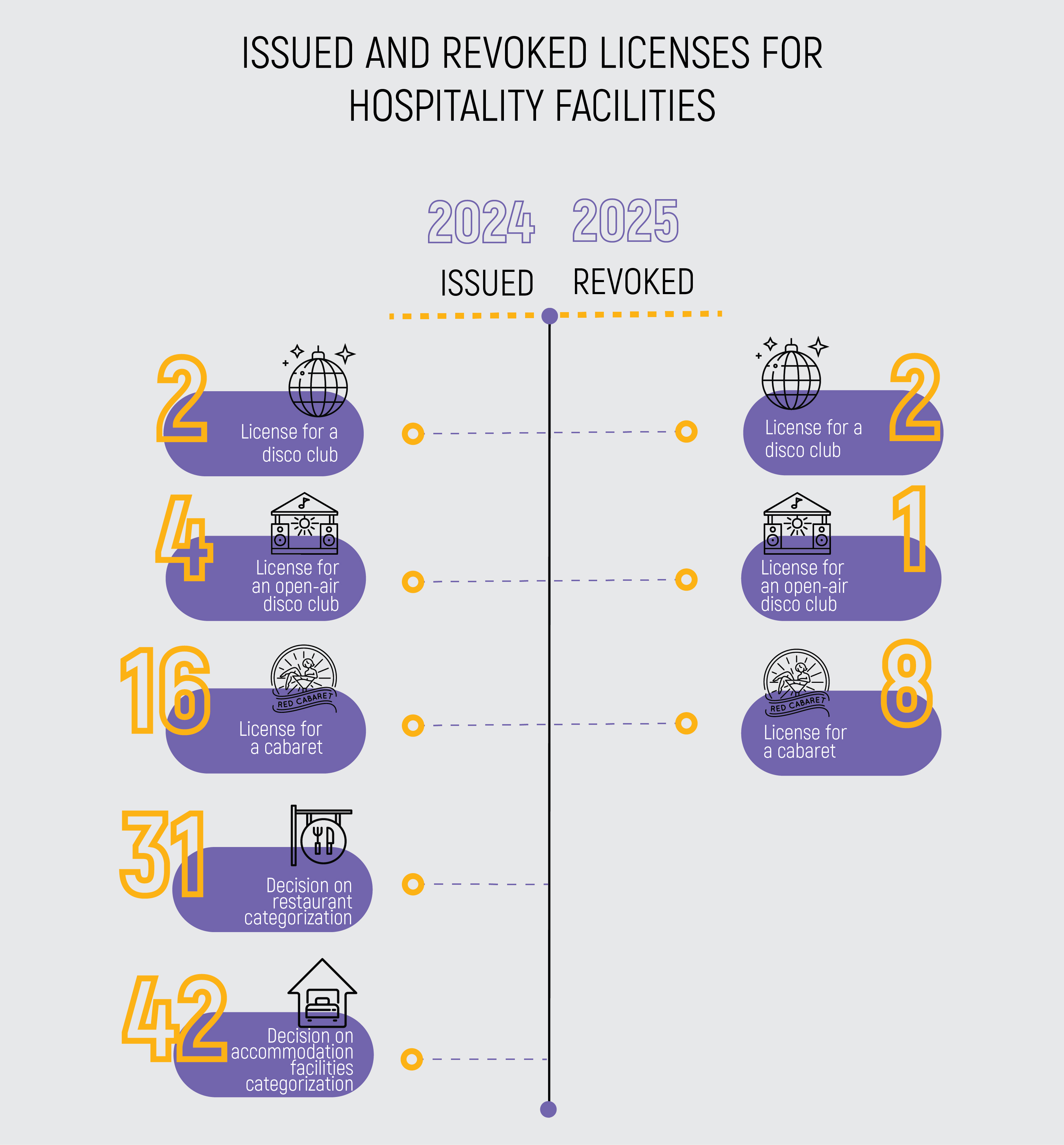
In 2024, the Ministry of Economy issued 2 licenses for disco clubs, 4 for open-air disco clubs, 16 for cabarets, 31 decisions on categorization of restaurants, and 42 decisions on categorization of hospitality accommodation facilities. In 2025, 2 disco club licenses, 1 open-air disco club license, and 8 cabaret licenses were revoked.
Due to an ongoing investigation, the documentation for issuing licenses for performing hospitality activities in night bars, cabarets, disco clubs, and open-air disco clubs was not available for audit.
The audit found that in 2024, the commission for categorization of hospitality accommodation facilities and hospitality food service facilities, composed of 13 members from eight institutions, did not comply with the statutory deadlines for preparing reports, while hospitality operators made payments for the service after the categorization was completed instead of upon submission of the application. Of the envisaged 60 regular inspections, only 40 were carried out, while extraordinary inspections were not conducted at all.
For the identified shortcomings, the audit issued recommendations, and the competent authorities are obliged to take appropriate measures for their full implementation.